Saturday, September 13, 2014


Wednesday, September 3, 2014
Art and craft of india
Bidriware bidar
and Hyderabad
Banjara
Needle work
Telangana, Hyderabad
Silk kanchi puram
Stone carving work mahabalipuram
Ivory Mysore
Marble Agra and Delhi
Sandal wood Mysore and Bangalore
Him rock weavers Aurangabad
Bronze casting swami
malai
Bangles Firozabad
Carpets vidisha Madhya Pradesh
Carpets and shawls Kashmir
Walnut wood work Kashmir
Pottery work
Gujarat
BEAD MAKING KHAMBAT: Just an hour's drive
from Ahmadabad,
Bandani designs Jamnagar
Gujarat
Brassware
jaipur
and Moradabad in up
.
SHELL
CRAFT ANDAMAN NOCBAR
COCONUT
SHELL ANDAMAN NOCBAR
BILLIARD
STICKS OF MARBLE WOOD ANDAMAN
NOCBAR
MITHILA
PAINTINGS BIHAR
Delhi
is famous for
IVORY
CARVING,
LEATHER WARE ,
MUSICAL
INSTRUMENTS,
Paper work ex kite, Tazia
ZARI,
GOTA, KINARI & ZARDOZI-
Phulkari Patiala Punjab
Pranda Patiala
Punjab
Wood
inlay work Hosiarpur Punjab
Wood
work piri Hoshiarpur, kartarpur Punjab
Jooti Mukatsar, faridkot Punjab
Dolls Chandigarh Punjab
Chmba in himachal is famous for
Chamba
Chappals
Chamba Rumal
Chamba shawl
Chamba shawl
Cast metal work & sheet metal work
Wood carving
Musical instrument making
Wood carving
Musical instrument making
Traditional jewellery making
Tuesday, August 26, 2014
KANGRA DEVI---JWALA MATA---CHINTA POORNI DEVI --VISIT HIMACHAL
Bajreshwari
Devi
Temple ------------kangra

It is not known when Bajreshwari Devi was built. History reports that the temple was
attacked in 1009, by Mohammed Ghazni, a Muslim ruler . In 1905, a devastating
earthquake flattened the original temple . Bajreshwari Devi Temple was reopened
in 1920, annual festival of Makar Sankranti is famously celebrated at Vajreshwari Devi. The holy
tradition of applying ghee to the goddess idol, followed by a washing of cold
water 100 times is still performed. Afterward the idol is decorated by flowers

Time
to Visit Good time to visit
kanga Devi is Mid June to Late
Oct
Place to visit
Kangra fort
Chamunda devi temple
Jwala ji temple
Bagla mukhi temple
Rock cut temples of musroor
|
Reaching the Temple
By Air: Nearest Airport is Gaggal which is connected with
New Delhi and Chandigarh
The nearest rail head on the narrow guage line is at kangra
Jwalaji temple----JWALA GEE himachal pradesh  |
Jwalaji temple one of the 51 Shakti-Pitha temples in India is located
at a distance of 34 km south of Kangra Valley. Dedicated to Goddesses
Jwalamukhi with flaming mouth. These flames may be seen erupting from a
rock-side. This flame is worshiped as a manifestation of the goddess
Jwalamukhi. the temple is believed to have nine permanent flames named
after the goddesses- Mahakali, Unpurna, Chandi, Hinglaj, Bindhya Basni, Maha
Lakshmi, Saraswati, Ambika and Anji Devi. Besides, there are Gorakh Dibbi, Chaturbhuj
temple and many small shrines situated in the vicinity of Jwalji temple.
Poorn Brahma Jyoti Jwala Mukhi.

Poorn Brahma Jyoti Jwala Mukhi.
The temple had
an associated library of ancient Hindu texts. According
to the legend, when Sati's body was divided into 51 parts, Sati Mata's tongue fell
here. When they fell they were on fire. The fire hasn't blew off. A cowherd found that one of his cows was always without milk.
He followed the cow to find out the cause. He saw a girl come out of the
forest, drink the
cows milk, and then disappear in
a flash of light. The cowherd went to the king and told him the story. The king
was aware of the legend that Sati's tongue had fallen in this area. . He built
a temple there . It is believed that the Pandavas came later and renovated the
temple.
 Gorakh Dibbi

pandav cave
pandav cave
It was
Dhyanu Bhagat who spread Devi Mata's name. He lived at the time of the Mughal
Emperor Akbar. Dhyanu Bhagat was passing through Delhi with a group of pilgrims
on their way to Jwalaji. Akbar summoned him to his court to inquire into the
nature of their Goddess. Dhyanu Bhagat told him She is all powerful and answers
the prayers of Her devotees.
To test Her power Akbar cut off the head
of Dhyanu's horse ordering him to have the Goddess put it back. Dhyanu went to
Jwalaji and prayed day and night to no avail. Out of desperation he cut of his
own head and offered it to Devi Ma. She then appeared to him riding a lion. She
reconnected both his head and that of the horse. Devi Ma also offered Dhyanu
Bhagat a boon. He requested that it should not be so difficult for pigrams to show
their devotion. Mata said that in the future if someone offered a coconut she
would accept it as if they had offered their own head. To this day people
continue to offer coconuts to the Goddess in Her temples all over the world.
Jwala mata is Kuldevi of Bhatiya (now lives in Gujarat) and Bhardwaj Gutra
Brahmins.
Gorakh Dibbi
Gorakh Dibbi Just above the main temple room of Mata
Jwala Ji, is the Rudra Kund , famously as
the Gorakh Dibbi. At this Rudra kund, Maa Jwala is present in the form of Maa
Anjana Jwala Ji Jyoti.
1. Maa
Mahakali Jwali Ji
Maa Maha Kali. SHE is
situated in front across the main kund after entering the main temple gate and
her Jyoti is covered around with a silver temple case. She is in the form of a
Blue Jyoti and thus refered as Mata Mahakali. This form is world famous as the Poorn
Brahma Jyoti Jwala Mukhi. She is the giver of Mukti and Bhakti.
This is the main Jwala Maa Jyoti swaroop out of all the jyotis/ flames which
you should not miss.
2. Maa
Annapoorna Jwali Ji
Just below Mahakali Maa Jyoti is the second form of Maa Jwalaji
known as Mahamaya Annapurna Jwala Mata.
Maa Annapoorna is Bhandaar Bharnewali Maa.
3. Maa
Chandi Mata Jwali Ji
Mata Chandi Devi or Maa Chandika Jwala Jyoti is the destroyer of
enemies. She is the 3rd form of Maa Jwala Ji.
4. Maa
Hinglaaj Bhwani Jwali Ji
Maa Hinglaaj Bhawani is the remover or destroyer of obstacles.
She is the 4th roop/ form of Mata Jwalaj
5. Maa
Vindhyavasini Jwali Ji
Mata Vindhyavasini Devi which is the reliever from sorrow and depression.
SHE is also present in the front wall, across the main kund.
6. Maa
Maha Lakshmi Jwali Ji
SHE is present in the main kund. Out of the 4 main jyotis
present in the main kund after you enter the main temple room, on the right
most side at the bottom is the Mahalakshmi Jwala Maa.
7. Maa
Maha Saraswati Jwali Ji
Towards the left and little higher is Mata Mahasaraswati Jwala
Ji Jyoti. She is present in the main kund along with Maa Mahalakshmi. And as we
all know, Maa Saraswati is the Vidya and Gyan Datri.
8. Maa
Jwali Ji
The Eigth form of Maa. This jyoti is also present in the main
kund. This Maa Jyoti is present in the left most side in the main kund.
9 Maa
Anjana Jwali Ji
In addition to the nine forms of Maa Durga in the main temple
room, if you come out and move a few steps up to the Gorakh Dibbi which is
inside the temple parisar itself, you will find another swaroop of Jwala Maa.
Towards the north after climbing a few stairs is the Gorakh Dibbi is Maa Anjana
Jwalaji. She is present in the form of 2 flames and She is present in a water
kund known as the "Rudra Kund" where it is said that Guru Gorakhnath
had prayed Maa for a long time. Maa Anjana Devi Jwala Ji is the giver of long
life and happiness.
 Naga arjun temple


TEDA TEMPLE
CHHATTAR OFFERED BY MUGAL KING AKBAR
Near by temples
Naga arjun temple
Teda mandir
Time
to Visit Good time to visit kanga Devi is Mid June to Late Oct
Reaching the Temple
By Air: Nearest Airport is Gaggal which is connected with
New Delhi and Chandigarh
The nearest rail head on the narrow guage line is at kangra
|
Chintpurni Shakti
 |
| TEMPLE |
 |
| MAA KI PINDI |
 |
| OLD PIC OF BATHING GHAT |
the Chintpurni Shakti Peeth
is dedicated to the temple of Chinnamastika Devi one of the 7 major and 51 total Shakti Peethas. , There are 51 Shakti Peeth
associated with the 51 alphabets in Sanskrit Chhinnamasta, means
the headless goddess It is believed that parts of Sati’s Forehead
fell at this place .
According to Markandeya Purana, goddess Chandi
defeated the demons after a fierce battle but two of her yogini emanations
(Jaya and Vijaya) were still thirsty for more blood. Goddess Chandi cut off her
own head to quench Jaya and Vijaya’s thirst for more blood.
She is usually shown holding her own severed
head in her hand, drinking one stream of blood spurting from the arteries in
her neck, while at her side are two naked yoginis, each of whom drinks another
stream of blood.
According to Puranic traditions,
Chhinnamastika Devi will be protected by Shiva - Rudra Mahadev in the four
directions. There are four Shiva temples - Kaleshwar Mahadev in the east,
Narayhana Mahadev in the west, Muchkund Mahadev in the north and Shiva Bari in the
south - which are nearly equidistant from Chintpurni. This also confirms
Chintpurni as the abode of Chhinnamastika Devi.
Pandit Mai Das, a Saraswat Brahman, is
generally believed to have established this shrine of Mata Chintpurni Devi in
Chhaproh village in the ancient times. Over the time this place became known as
Chintpurni Hindu pilgrimage and marriage records were also used to be kept at
this holy place.


 |
| HANUMAAN AND SHANI DEV |
 |
| MAIN ENTRANCE |
Time to Visit Good time to visit
kanga Devi is Mid June to Late
Oct
Reaching the Temple
By Air: Nearest Airport is Gaggal which is connected with
New Delhi and Chandigarh
The nearest rail head on the narrow guage line is at kangra
|
Saturday, August 23, 2014


.JPG)

.JPG)


Monday, August 11, 2014
chamunda devi -himachal- india

Chamunda devi
|
The Chamunda Devi Temple in
Himachal Pradesh is located 10 km west of Palampur in the Kangra area of the
state. It stands on the banks of the famous Ban Ganga River, the temple is
housed with extremely sacred idol of Chamunda Devi, and as such the idol is
wrapped by a red cloth. The location of this sacred temple is also
significant since it is believed to be the same spot where the Mata or the
Maa Kali assassinated the demon kings Shumbh and Nisumbh. The two generals
were namely Chanda and Munda. It is their name that gave Goddess Kali, a new
name called Chamunda. She
is also one of the chief Yoginis, a group of sixty-four or eighty-one Tantric goddesses
|
Camunda is a combination of Chanda and Munda, two
monsters killed by mata. Temple of mata
was situated on hill named adhi
chamunda .Around 400 years ago the king
and a Brahmin priest prayed to Devi for permission to move the temple to some
easily accessible location. Devi appeared to the priest in a dream giving her
consent. .
Inside the temple of Chamunda Devi, it is accompanied by the images of Hanuman
and Bhairo. There are inscription to be seen from the Devi Mahamaya, Ramayan
and Mahabharata. The surroundings of the Chamunda Devi temple are considered
just perfect for those who are interested to meditate and pray.The famous Chamunda Nandikeshwar Dham is an abode of Shiva Shakti since the saga of
Puranas.
The goddess is
worshipped by ritual animal sacrifices along with offerings of wine and in the
ancient times, human sacrifices were offered too. Originally a tribal goddess,
Chamunda was assimilated in Hinduism and later entered the Jain pantheon too.
Though in Jainism, the rites of her worship include vegetarian offerings, and
not the meat and liquor offerings.
Research work is going on the period of construction and other mysteries
surrounding the temple.
The temple
is seven hundred years old.
Research work is going on the period
of construction and other mysteries surrounding the temple.

The Myth of the Temple
|
The mythology of Maa Chamunda Devi
has been chronicled in "Durga Sapt-Shati'. The Story goes like this- the
two great demons namely the Chand and Mund led a huge army with weaponary on
being ordered by their king 'Shumb' and 'Ni-Shumb'. Both saw goddess sitting
on a peak of Himalaya and the goddess was smiling, as the goddess was
unarmed, the two demons tried to catch hold of her. Then the whole army took
up their arms and encircled goddess. The goddess got enraged and furious and
it seems that her whole body became black with anger and eyebrows raised on
forehead. Then with the Maa Amba’s austerity immediately, 'Kali-Devi'
appeared with a sword in her hand and roared violently. Maa Kali was covered
with a garland of human heads which was gracing her neck and while the body
was covered by tiger-skin. Maa Kali’s skin looked dry and her shape
ferocious. And the most important expression was that she had eyes drawn deep
and mouth wide open and tongue brandishing violently.
|
Temple is the place where the two
great demons 'Chand' and 'Mund' came to fight with goddess, while goddess appeared
in the form of Kali and killed both the demons. When 'Kalika' defeated the two
demons with presenting the heads of 'Chand' and 'Mund' to the goddess Amba,
from whose prowess Kalika was created, then the goddess became happy. Later the
Goddess Amba gave a boon to Kalika that she will be remembered and worshipped
as Chamunda.
Maa Kali’s roar trembled the skies
and attacked the demon army swiftly killing the demons mercilessly and ate
them. Whosoever came in her path was killed and swallowed by her even the
bodyguards, elephants, soldiers along with their weapons. In similar fashion
Maa Kali put in her mouth, chariots along with horses and drivers and chewed
them making a horrifying noise. At some point of time she would grab people by
neck and somewhere she would catch hold of hair. She would swallow the arrows
and other weapons thrown on her by the demons. In this way the goddess Kali put
an end of the demoniac army, by killing and devouring them.
Significance
of the temple
Chamunda Devi is worshipped daily
while the sermons include ‘Aartis’ at intervals. Reciting the hymn of 'Shat
Chandi’ with devoted heart at this temple is considered auspicious. In the
corner of the temple, one can see small footsteps of the Goddess on a stone.
Besides the main shrine, there is a marble staircase that takes down to the
cave of Lord Shiva. This is a cave-like scoop where Shiva Lingam is placed.
People visit this cave and worship Lord Shiva with great devotion.
Lord Shiva is believed to be one of
the complex Gods of the Hindu pantheon, as Lord Shiva is the destroyer as well
as the restorer. Here, Lord Shiva is believed to have been present in the
strange form of death, destruction and dead bodies. The find observation is
that the ancestral worship near the banks of Ban Ganga River. In the vicinity
of the Chamunda Devi temple, there is a cremation ground that serves to 22
villages of the nearby areas.
|
|
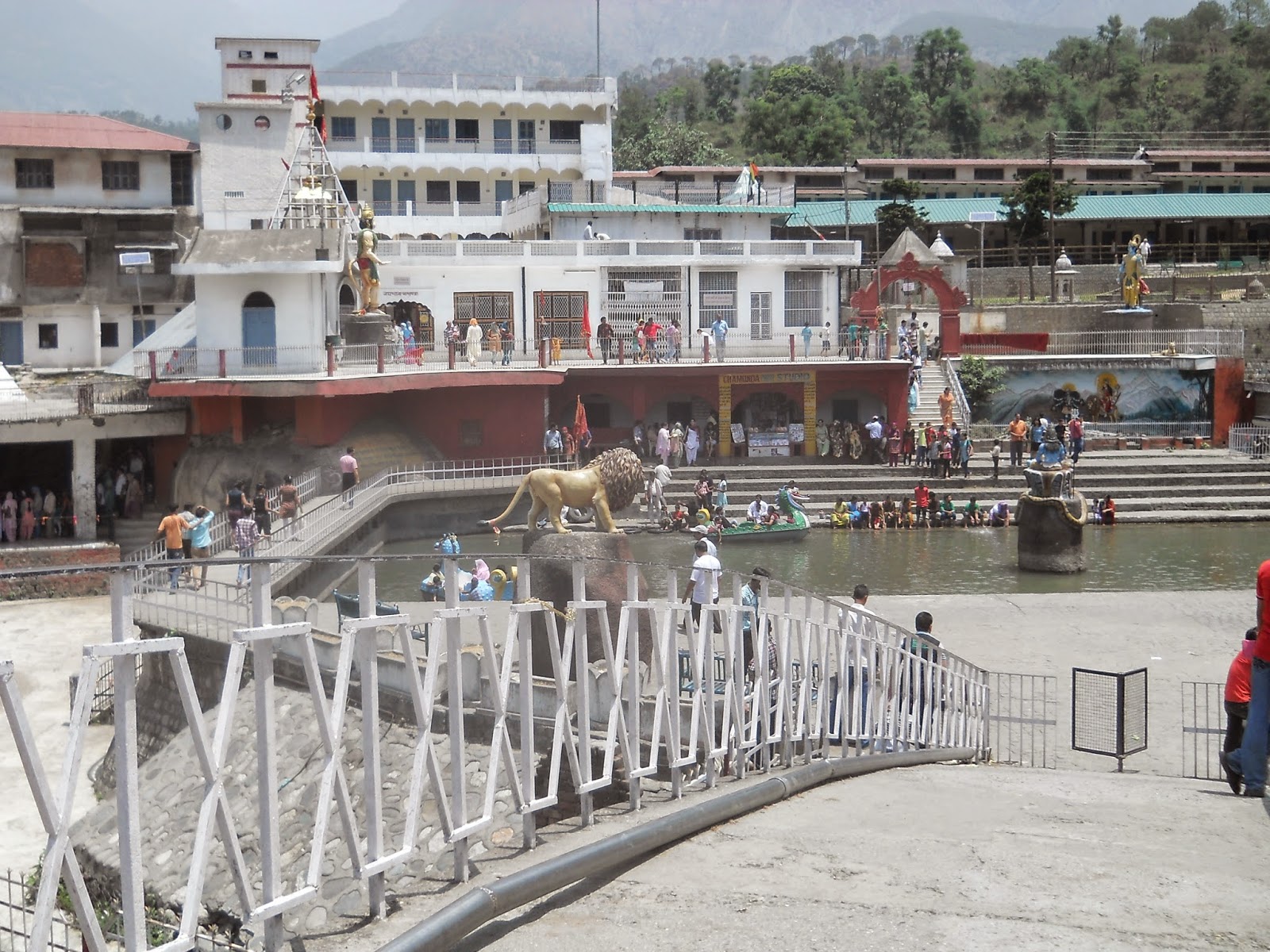
In the temple surroundings there
is a huge pond with images of Lords and people can take bath here. There is
sculpture of Goddess where she is garlanded with serpents, scorpions, and
skulls. During the time of Navratras, the Chamunda Devi temple is crowded by
large number of people. Pilgrims from far and near of the country come to
visit this temple of great legacy and religious importance. Chamunda Devi
blesses all her true devotees. The temple is so very auspicious that it is
situated in the picturesque beauty of lush green mountains. Many saints can
be seen here involved in penance and meditation.
|
The Chamunda Devi Temple is 700
years old and is a big area of worship with even a kund (tank) where devotees
take a dip. The idol in the main temple is considered so sacred that even the
eyes of devotees who come for dashing are not allowed to touch upon it; it is
kept completely concealed beneath a red cloth. At the back of the temple is a
cave-like scoop where a stone lingam (phallic symbol of Shiva) under a boulder
represents Nandi Keshwar (Shiva).


Gods
form and explanation
Chamunda Devi Temple is a very
scared renowned holy shrine of the Hindus. This ancient temple dates back to
the 16th century and is dedicated to Chamunda Devi, mata in the form of Durga /
Shakti. Chamunda Devi Mandir is also said to be the abode of 'Shiva and
Shakti'. Such that it is also known as 'Chamunda Nandikeshwar Dham'.
Mata Chamunda Devi is considered
like the wrathful form of Durga, but even at the same time, the Goddess is kind
to her true devotees.
Time
to Visit
In winter, the temperature can get
quite cold; it may even fall up to normal weather degree when woollens are
required. It is hot in summer and cottons are recommended. Good time to visit
Chamunda Devi is Mid June to Late October.
Other
places to Visit
|
Ayurvedic dispensary, library and
a Sanskrit college situated in the temple complex.. The library comprises of
rare collection of old manuscripts, books on astrology, Hindu philosophy,
Vedas, Puranas, Upnishads, Sanskrit and History.
|
Reaching the Temple
|
i.
By Air: Nearest Airport is Gaggal which is connected with
New Delhi and Chandigarh by
Indian Airlines Flight.
ii.
The nearest
railhead on the narrow guage line is at Moranda near Palampur, 30 km. The
nearest railway station to the temple is Pathankot for broad gauge trains and
there is also a narrow gauge train in Kangra district for which the railway
station is Nagrota Bagwan.
iii.
Chamunda Devi
is 15 km from Dharamsala and 55 km from Jwalamukhi.Chamunda is situated 10 km
west of Palampu.
|
Subscribe to:
Posts (Atom)